
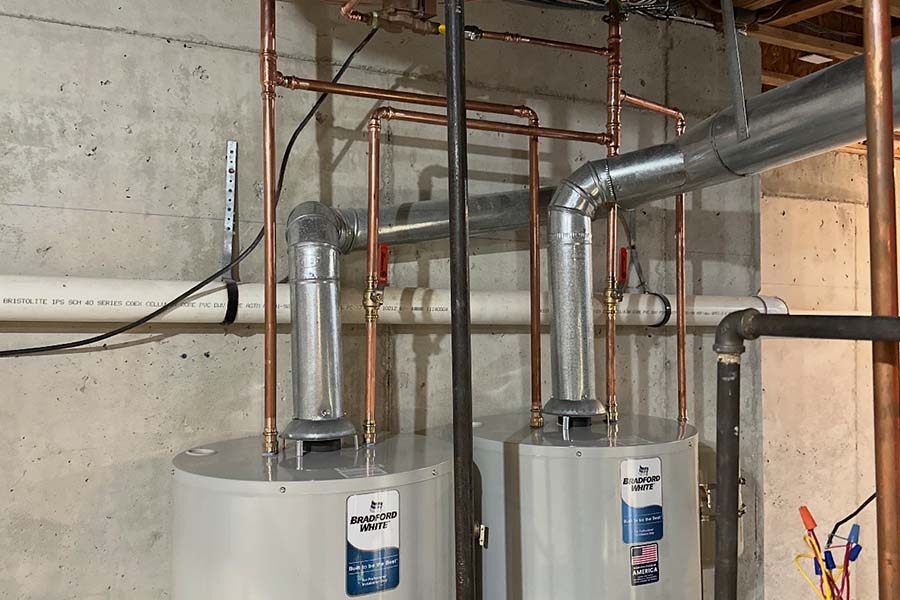
Delaying water heater replacement costs more than most Oakland homeowners expect. An aging unit burns extra energy every month, grows more likely to leak as the tank corrodes, and can fail suddenly in a way that damages far more than the water heater itself.
Titanium Plumbing & Heating is licensed, bonded, and insured, with same-day appointments and weekend availability across Oakland and the surrounding towns.
Key Points
- Most traditional tank water heaters serve eight to twelve years before replacement is due.
- An aging unit uses more energy to deliver the same hot water, which shows up on monthly bills.
- Rumbling, reduced hot water, inconsistent temperatures, and rust or moisture are the standard failure warnings.
- A tank that is leaking from the tank itself cannot be repaired, only replaced.
- Water damage and mold remediation after a failure routinely cost more than a planned water heater replacement.
What Does Delaying Water Heater Replacement Actually Cost?
The cost starts well before the unit breaks. A water heater running past its prime works less efficiently, consuming more energy to deliver the same hot water, and that shows up on monthly bills without most homeowners connecting the two.
A complete failure is where the number jumps. A tank that gives out can release its full volume, damaging flooring, drywall, and nearby structures. The Department of Energy notes that water heating is one of the largest energy uses in a typical home, which is why an inefficient unit is expensive to keep running.
In our service calls throughout Oakland and the surrounding Bergen County area, delayed replacements have led to repair costs that dwarfed the price of a new unit. Scheduling water heater installation and replacement before failure is almost always cheaper.
How Long Does a Water Heater Last, and What Are the Warning Signs?
Most traditional tank water heaters have a serviceable life of eight to twelve years. Age is not the only factor. Mineral buildup, sediment accumulation, and internal corrosion shorten that life considerably, particularly where water hardness speeds those processes along.
The common warnings that a unit is nearing the end are rumbling or popping during heating cycles, a drop in how much hot water you get, temperatures that swing, and visible rust or moisture around the base.
Based on what we see in Oakland, NJ properties, homeowners who act on these early indicators avoid most emergency situations. Where a repair is the right answer, prompt water heater repair by a licensed technician restores performance and extends the remaining life.
How Do You Check the Age of Your Water Heater?
Look at the rating plate on the side of the tank. Most manufacturers encode the build date in the serial number, and many print the manufacture date outright.
Serial number formats differ by brand, so the decoding is not universal. If the plate is unreadable or the format is unfamiliar, the brand’s support site or a technician can identify it in seconds.
Knowing the age turns the decision from a guess into a plan. A unit inside its expected window with no symptoms can wait. One past that window, or showing any of the warnings above, is on borrowed time regardless of how it seems to be running, and worth planning a water heater replacement around.
Repair or Water Heater Replacement: How Do You Decide?
The age of the unit and the nature of the fault decide it. A water heater still comfortably within its service life with a failed thermostat, heating element, or valve is usually worth repairing, since those are components rather than the tank.
Water coming from the tank body itself is different. Once the tank has corroded through, there is no repair, and water heater replacement is the only option. That is the single clearest signal in the whole decision.
Between those cases, the pattern matters more than any one fault. A unit approaching the end of its window that has needed repeated attention is spending your money in installments. Putting that toward a new unit buys back the efficiency and removes the failure risk at the same time.
What Are the Safety Risks of an Outdated Water Heater?
An aging water heater is a legitimate safety concern rather than an inconvenience. As the tank interior corrodes, the risk of leaks, pressure buildup, and in severe cases catastrophic failure rises. Deteriorating components on a gas unit can also allow harmful gases to accumulate.
Working in homes across Oakland, including older properties near Ramapo Valley Road and along the Ramapo River corridor, our team regularly finds water heaters well past their intended lifespan. Those risks are real and worth taking seriously.
For homeowners after both safety and long-term efficiency, tankless water heater installation is a strong option. Tankless systems remove the standing water that drives tank corrosion and carry a significantly longer service life.
How Does a Failed Water Heater Damage the Rest of the House?
A water heater failure rarely stops at the unit. When a tank leaks or ruptures, water moves into walls, under flooring, and into the ceiling cavities of any level below, and even a short delay creates the conditions for mold growth and structural deterioration.
Water damage repair and mold remediation together frequently exceed the price of a new installation by a wide margin. Delaying also makes a sudden uncontrolled failure more likely than a planned upgrade on your schedule. Where a failing unit has already started leaking, immediate water leak repair contains the damage before it spreads.
What Do You Gain by Replacing on Your Own Schedule?
A timely water heater replacement does more than avoid an emergency. Modern efficient units heat water using less energy, which reduces monthly costs across the whole life of the unit.
Newer systems also bring better warranties, improved safety features, and components built to current standards. Replacing proactively means you have time to compare fuel types and sizes and pick a system genuinely matched to the household. Waiting for a failure means a rushed choice and whatever scheduling is available.

Frequently Asked Questions
How do I know if my water heater needs replacing or just repairing?
Check the age first, then the fault. A unit inside its eight to twelve year window with a failed component is usually repairable. Water leaking from the tank body itself is not repairable at any age and means replacement. A unit near the end of its window that has needed repeated repairs is generally worth replacing rather than fixing again.
Is it cheaper to replace a water heater before it fails?
Almost always. A planned water heater replacement is the cost of the unit and the installation. A failure adds whatever water damage follows, plus emergency scheduling and a rushed equipment choice. The efficiency gain from a modern unit also starts reducing bills immediately rather than after the emergency.
What happens if I keep using an old water heater?
It keeps working until it does not, and the failure mode is the problem. Efficiency falls as sediment builds, the corroding tank becomes more likely to leak, and a gas unit with deteriorating components carries added risk. The unit rarely gives much warning between working and releasing its contents.
Protect Your Oakland Home with a Planned Water Heater Replacement
Putting off water heater replacement in Oakland, NJ compounds risk on several fronts at once: rising energy bills, unreliable hot water, property damage, and safety hazards. Replacing a declining unit before it fails is the cheaper and calmer path.
If your water heater is showing wear or nearing the end of its expected life, contact our team today to schedule an evaluation and go over your replacement options.